Graphic Design is the art of communicating with visual images. It has at its very core the desire to connect to and inform another human being. When looked at in this sense it’s easy to see how it could have developed from our more primitive ancestors. It’s having a conversation in another language, the visual one. Before, history began being recorded in a physical sense there was an oral history. Legends and stories would be passed down from village elder to the younger generation.

And for a time, this was good. It passed down knowledge from one generation to the next allowing the tribes base of knowledge to grow and expand, but there are some problems with trying to preserve information this way. Being passed from one person to another leaves room for change and human error in the retelling of it. There is also the issue of the mortality of the teller; to make it to the present the information would have needed to be passed down an unbroken chain of successors for thousands of years. With our current knowledge of the human lifespan this is highly unlikely. One can only imagine the countless things lost to the sands of time in this method.
The quantum leap came when these original people began to use a more visual language. There are examples of this first step in the cave paintings and petroglyphs discovered in caves around the world.

This small step may not seem like it has the same richness to it that an oral story would, but this graphic representation is a moment frozen in time. A painting on the wall that has lasted to the present is a marvel in that it is unchanged and provides us with a glimpse into the world of our ancient ancestors. Instead of hearing a change and diluted tale of the hunt, we can SEE it. This would have been very powerful to the paleolithic people. Pictographic communication is not without it limits though. The details of the events can be lost and the images that depict those events are dependent upon the skill of the artists and the interpretation of the viewer. As time moved on, there was a movement towards the simplification of these images and historians theorize that this led to the emergence of written language.
The ancient Mesopotamians are often credited with the creation of many advances in human culture and technology such as agriculture, animal domestication and the development of metal tools. The Sumarians, who settled in the land of Mesopotamia are believed by archaeologists to be one of the first civilizations to create a writing system. This advance had a dramatic effect on human culture. As the village culture moved into one of a city, many accounting problems for the distribution of resources to maintain a large amount of people living together arose. Many historians theorize that the writing system arose due to this desperate need by temple scribes to account for all of this information.
Example of Sumarian Cuneiform
The development of this system of communicating information made those that could understand and write it VERY powerful in their societies. In fact, being a scribe was a prerequisite to priesthood, estate management, accounting, medicine and government. The power of the writing system among the select was repeated in the Egyptian society, with their famed hieroglyphics.
Scribes in Egyptian society had immense power, in fact their writing had a large religious aspect to it. The Egyptians had an extremely superstitious culture centered around the afterlife. There was a belief that one could predict what would happen after one died through the use of a scribe writing down the story. These came to be know in popular culture as Books of the Dead, and were in fact some of the first examples of illuminated manuscripts.

This discrepancy in knowledge and power began to equalize only later with introduction of several advances in both language and technology. Alphabets, or writing systems that use phonographs in which the basic speech sounds of a language are represented, began to form, making literacy more accessible to the common person. "The Northwestern Semitic peoples -Canaanites, Hebrews, and Phonecians- are widely believed to have been the source [of the alphabet] (Meggs 19).
The most famous users of the alphabet, the Greeks, used it to develop science, philosophy and democracy.
The other advance that greatly evened the scales was the development of printing and paper. Both of these leaps forward in human development were invented by the Chinese. The printing process is actually quite simple, the space around an image on a flat surface is cut away, and the remaining raised areas are inked and a piece of paper is place over the surface and rubbed to transfer the image to paper.
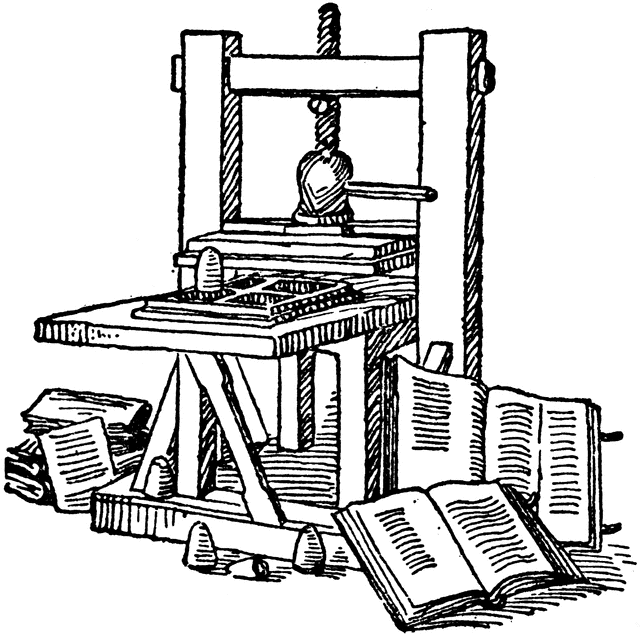
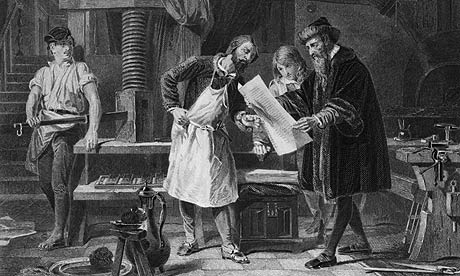
The Chinese used this technology to create a paper currency which was widely distributed and many of the populus were exposed to printing and the word. This aspect of Chinese history led to an Eastern Intellectual Renaissance of science, art, medicine and poetry. This is comparable to what Guttenburg's press did for the West hundreds of years later.
These chapters have really opened my eyes to the grow of human culture and how closely the visual language has been tied to it. One might even say that all of our current advances have come from the compiling of this information over hundreds of thousands of years, slowly building upon those that have come before us.