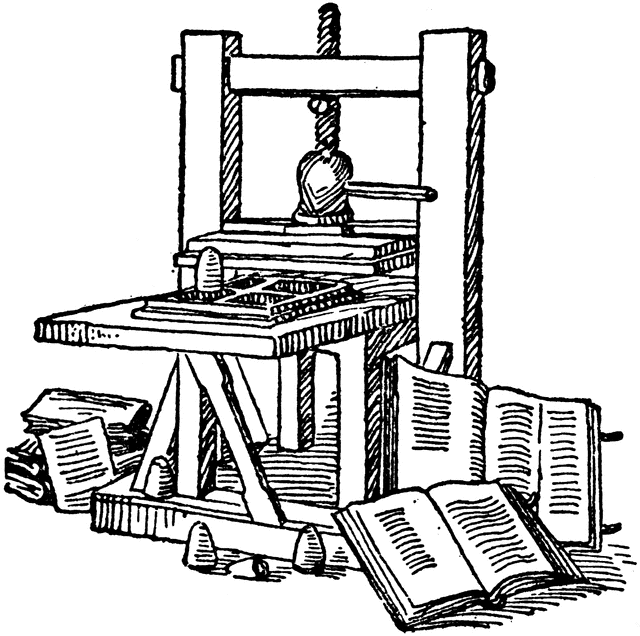
Prior to the development of the printing press by Johannes Gensfleisch zum Guttenburg, books were all written by hand. In fact a production line style of book making controlled by the clergy and the wealthy had been in place for years. A single book before the printing press possessed the same value as a farm or vinyard!
The name Incubala has been adapted for the period of time and the books printed after the creation of Johannes' press. This was a time in which not only the printed word spread rapidly, but the process of printing itself. As it states in Meggs History of Graphic Design, "By 1480 twenty-three northern European towns, thirty-one Italian towns, seven French towns, six Spanish and Portuguese towns and one English town had presses. By 1500 Printing was practiced in over 140 towns. It is estimated that over thirty-five thousand editions for a total of nine million books were produced."
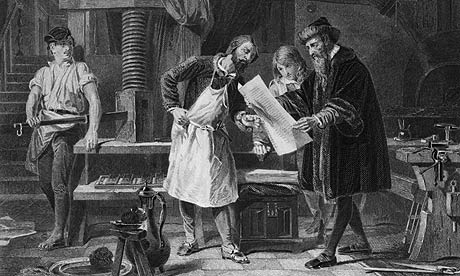 Just 50 years earlier, the monasteries and libraries of Europe had only contained around fifty thousand volumes. That MASSIVE increase in literature made the literacy rates around Europe leap to a previously unheard of high. The mass production of books and their effect on literacy was two-fold. The increased supply of books greatly brought down their monetary value to a fraction of what it had been previously and the mere fact that there were more books in circulation gave more people access to physical copies.
The rise of literacy also gave rise to the many social and political upheavals that took place in Europe in the last couple of centuries. The fact that so many could now read and the ease with which mass copies of written material could now be created led to an intellectual revolution as new ideas and values could be spread to the masses. This led to the destabilization of the European religious authority's power base as so much of it depended on controlling the flow of information, much like the scribes of Sumeria and Egypt. This weakening of the Clergy's informational authority led to the spread of Humanism and Individualism, a hallmark of our current society.

The study of this great upheaval and social change 500 years ago, gives me pause as I can see parallels between it and the current change that we are going through as a culture and as a species. The flow and spread of information, once limited to books and print, now lives in the chips and drives of our computers. Instead of movable type, we now have word processing programs, e-mail, and blogs. Instead of illuminated manuscripts we now have photoshop and jpegs. In place of paper we have light projected directly into our eyes from our screens. Information is now free to those with an internet connection and a power source, in fact, one can view computer literacy as the new literacy. The rise of the internet and personal computing has done as much for the spread and exchange of information and ideas as the printing press did and more.

It's interesting to note though, that the printing press led to learning being a more individual and personal act leading to individualism and the spread of different ideas. In the current trend, information is more open and with the rise of social networking sites it is instantly share-able and spreadable much like a virus, from person to person. I wonder though, if this will lead to more of a homogeneity of ideas and information as we all begin to draw from the same sources, such as the front pages of sites like Yahoo, or Youtube. Hopefully not as variety is what makes life so interesting.
With the rise of cloud computing, I also wonder if the preservation of information will be a personal thing any longer as more and more documents, videos, and other information are saved on the servers of other more powerful computers that are owned by corporations. But like the Europeans of the past half millennium I can only speculate on what changes this new technology will bring and I look forward to finding out.

No comments:
Post a Comment